The British Psychological Society Approved through the BPS Quality Mark Scheme.
64
modules
98
days
525
hours
The BPS Approved Master Practitioner Diploma is designed to provide students with a comprehensive skills and theory based training in Cognitive Behavioural Therapy covering in total 525 hours (min requirement 450 hours) of training via direct tutor training, video demonstrations, practice, interactive online modules, post-course reading with assessed online tests (Evidenced Reading) and Case Formulation submissions.
Through these means, the course enables students to achieve a proficiency in CBT and receive a Master Practitioner Diploma in CBT (MPD CBT) on completion.
The BPS Approved Master Practitioner Diploma is designed to provide students with a comprehensive skills and theory based training in Cognitive Behavioural Therapy covering in total 525 hours (min 450 hours) of training via different learning methods: direct tutor training, video demonstrations, practice, interactive online modules, post-course reading with assessed online tests (Evidenced Reading) and Case Formulation submissions.
The course is designed to largely be based on a 50:50 Theory/Skills split.
Through these means, the course enables students to achieve a proficiency in CBT and receive a Master Practitioner Diploma in CBT (MPD CBT) completion.
The structure of the Diploma is modular. Each module is designed to be an individual self-contained course on a chosen topic. Most are designed around problem areas, whilst others look at strategies, techniques and professional/ethical issues. All modules are designed in such a way that they can be taken in any order or individually, although it is recommended that you take the Introductory 3 day Certificate (CBT: Introductory Course) EITHER first OR close to your first few Diploma modules.
There are more hours available in CBT Diploma Modules (525 hours in total) than the minimum requirement of 450. The additional courses give you more flexibility in choosing the topics that of relevance to you and your professional development. CBT: Introductory Course and Socratic Questioning Workshop (or SQ for Eating Disorders) are the mandatory modules for this Diploma.
The Diploma as a whole is designed for those with a first degree and is taught at a university post-graduate level. However, individual course modules are open access.
We are moving to a “flipped learning model”. In plain language that means that all your training course modules (but one) can be accessed instantly via recording which you can view at anytime and anywhere. Certain modules are available as both live zoom courses and recordings. The choice is yours.
Once you’ve signed up for the Diploma, your training course gains THREE ADDITIONAL FEATURES:
Exclusive Access to an ANNUAL FREE 1 hour CBT supervision with Paul Grantham, Course Director
Exclusive FREE Access to the full library of past CBT tutorials
UNLIMITED email support with Paul Grantham, Course Director
We allow you to complete the modules of the course at your own pace according to your personal circumstances although typically it is anticipated that this should be completed over a 1-2 year period. Fees operate as EITHER discounted payment for the whole Diploma in advance OR on a module by module basis.
Specific Case Formulations form part of the self-directed skills element of the Diploma. There are fourteen of such modules representing a total of twenty eight case formations and treatment plans that require submission. Further Details about Case Formulations
Most Training modules also have assessed reading lists (Evidenced Reading) attached to them. Chapters, articles and web pages typically have public domain availability minimising the need to purchase books for the course. Each reading list is assessed via an online test which are designed as simple methods of checking that reading has occurred and been understood rather than as an onerous obstacle that students should be expected to “cram” for. The tests may be taken as many times as is necessary in order to reach the Pass mark (which is 75%). Further Details about Evidenced Reading
Our course tutors are all Accredited CBT Therapists and/or Accredited CBT Tutors, are extensively experienced both as practitioners and CBT Trainers. The course Clinical Lead is Paul Grantham, Consultant Clinical Psychologist, Founder and Director of SDS Seminars.
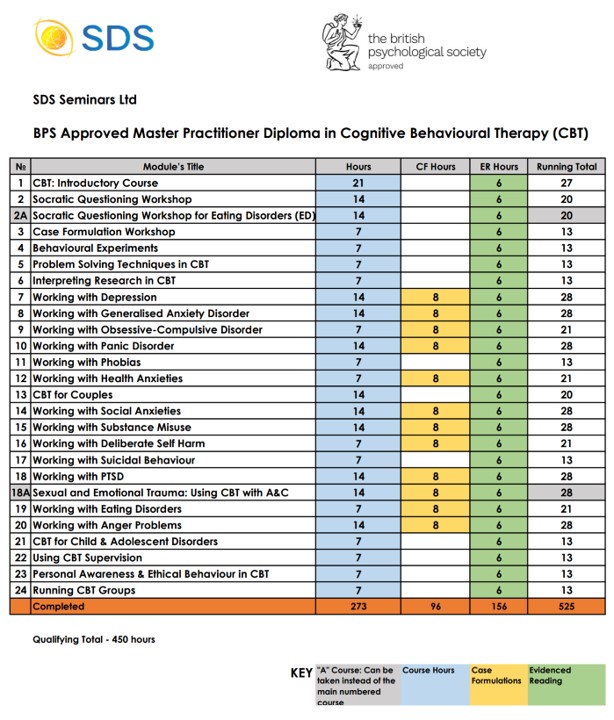
There are more modules available than the minimum requirement so you can have a certain degree of flexibility in choosing your topics.Course Outline in a table format.
Once you’ve signed up for any Module of the Diploma your training has THREE NEW ADDITIONAL FEATURES:
Exclusive Access to an ANNUAL FREE 1 hour CBT supervision with Paul Grantham, Course Director
Exclusive FREE Access to the full library of past CBT tutorials
UNLIMITED email support with Paul Grantham, Course Director
Diploma Payment Options
Option 1:
Spread the cost - pay per course as you go along. This option gives you a lot of flexibility in terms of allocation of your time and finances.
Option 2:
Pay for the whole course and save over 30%: £5000 + vat (£6000)
This is over £2500 saving in total.
This option protects you from a potential future price increase and also enables you to save almost a third off the Diploma price.
CLICK HERE if you want to achieve Level 4 Accreditation (Proficiency) after completing the Diploma.
SDS Accreditation Levels for CBT Training
Foundation Stage, Level 1
Level 1 (Foundation Stage) is the level you obtain by attending the CBT: Introductory Course, completing the relevant Evidence Reading Module and passing the online test.
This level gives you a BPS Approved Certificate, and enables you to state in your CV that you have Level 1 (Foundation) as a CBT Practitioner, and use PCBT (Foundation) qualification in your title.
Without further training, your level currently lasts for 3 years, after which you cannot make the above statement. However, continuing training in CBT with SDS Seminars after the completion of your CBT Introductory Course enables you to extend this level beyond the initial expiration date. Should you let your level lapse, you need to retake CBT: Introductory Course.
SDS Accreditation, Level 2
SDS Accreditation Level 2 means you have completed all the hours allocated to the Diploma training courses, but not CF and ER modules.
This level of accreditation gives you a BPS Approved Certificate in Essential CBT Skills, and enables you to state in your CV that you have Level 2 Accreditation in Essential CBT Skills qualification.
Your accreditation currently lasts for 3 years, after which you cannot make the above statement. This level of accreditation is renewable by continuing training in CBT with SDS Seminars after the completion of your Certificate. (Full list of the appropriate training courses is available from SDS Seminars Ltd).
SDS Accreditation, Level 3
SDS Accreditation, Level 3 (Master Practitioner in CBT, Assessed Academic Competence) means you have completed all the hours required by SDS Master Practitioner Diploma in CBT and also passed all the online exams.
You obtain this level of accreditation by completing SDS’ modular Master Practitioner Diploma in CBT, by completing the relevant Evidenced Reading and Case Formulation modules, and by passing all the online tests associated with the Diploma.
This level of accreditation gives you a BPS Approved Master Practitioner Diploma in CBT, and also enables you to state in your CV that you have Level 3 (Assessed Academic Competence) Accreditation as a Master Practitioner in CBT and use MPCBT (AAC) qualification in your title.
You will also be given an option to be listed in the SDS Register of CBT Practitioners – our Network of Qualified CBT Practitioners.
Your accreditation currently lasts for 5 years, after which you cannot make the above statements and access course resources. This level of accreditation is renewable by continuing training in CBT with SDS Seminars after the completion of your Certificate. (Full list of the appropriate training courses is available from SDS Seminars Ltd).
SDS Accreditation, Level 4
SDS Accreditation, Level 4 (Master Practitioner in CBT, Proficiency) is as Level 3, with the addition of a Final Assignment consisting of:
A work-based assignment set by SDS of between 4,000 and 5,000 words. The assignment is designed to help you demonstrate your ability to apply the learning you have proved at Level 3 to a clinical situation in a considered way. You receive feedback on the case you submit, regardless of whether or not it reaches the required standard. Read more...
A written statement from your Clinical Supervisor confirming the regularity and duration of your supervision with them and your Competence as a clinician practicing CBT. Your Clinical Supervisor should meet our qualification criteria. The purpose of this statement is to confirm your clinical Competence as a CBT practitioner and to ensure that your practice is regularly supervised and meets required standards. Read More...
This level of accreditation gives you a BPS Approved Master Practitioner Diploma in CBT, and enables you to state in your CV that you have Level 4 (Proficiency) Accreditation as a Master Practitioner in CBT and use MPCBT-P qualification in your title.
Your accreditation currently lasts for 5 years, after which you cannot make the above statements and access course resources. This level of accreditation is renewable by continuing training in CBT with SDS Seminars after the completion of your Certificate. (Full list of the appropriate training courses is available from SDS Seminars Ltd).
I am interested in some of the topics which are part of the Diploma course. I am not sure at the moment whether I want to do the Diploma.
Absolutely no problem. Each course is designed to be an individual self-contained day or days on a chosen topic. All modules are designed in such a way that they can be taken in any order or individually. You don’t have to be a Diploma course participant to attend the individual training days. All modules will obviously be from a CBT perspective, so that a familiarity with basic CBT concepts, either from the SDS CBT Introductory Certificate Course or from elsewhere, is an advantage but not essential.
Are these courses suitable for me just as individual training days on the chosen topic?
Absolutely. Each course is designed to be an individual self-contained day or days on a chosen topic.
I would eventually like to do a Diploma in CBT, but am not registered on the course at the moment. If I took the courses one by one, would they be able to count towards the Diploma later on?
The individual modules can be taken independently and accumulated towards the Diploma gradually. You don’t need to commit to the whole Diploma straightaway. SDS Seminars retains an individual delegate log of modules taken, which is available to the named delegate on request to enable them to see how they are progressing towards full completion of the Diploma.
Is there any particular order in which I need to attend the modules?
The order of the modules is flexible. However, it is highly recommended (but not essential) that you attend BPS Approved CBT Introductory Course as early as possible. Subsequent modules will extend skills and knowledge covered within this course.
Can anyone attend the individual courses and complete the full Diploma? (Admission Criteria)
Individual course modules are open access. However the Diploma as a whole is designed for those with a first degree and is taught at a university post-graduate level.
I am interested in the Diploma in CBT, however as I have done an introductory training at another training centre or university - could I proceed to the other modules?
Unfortunately, our experience has shown that there is such a huge degree of variation between the courses that we cannot accept other (non-SDS) introductory CBT courses towards the Diploma. Many are either too generic in nature (in our opinion) or are strictly Cognitive Therapy courses (rather than Cognitive Behaviour Therapy courses). This can mean that it is often difficult for such students to understand terminology or approaches referred to in the Diploma. Additionally, the Diploma is Approved by the British Psychological Society as a whole and no parts of it can be missed or replaced by other courses.
Could you let me know the exact duration of the course – I will probably have to work while doing this so need to see if it’s financially reasonable to do?
Time scale for completion of the course is flexible. However, we typically expect you to complete it within 12 – 18 months from the date of the first module you attend. All Individual modules are available to attend at least once during this time period. Please allow time in your planning for online modules and self-directed components (CF and ER). In general, we do not put any limit on the time period you complete the whole Diploma within. However, SDS cannot guarantee that the Diploma will run in perpetuity, therefore, delaying completion beyond 24 months (2 years) from your first module is done at your own risk.
Is there a time limit on completion of the self-directed modules like Evidence-Reading and Case Formulations?
Yes. You are expected to complete each self-directed module within 2 months of your payment. In exceptional circumstances this time might be extended, by prior arrangement. SDS will not accept your work if you go outside the time limit without informing us in advance and agreeing it with us. Unauthorised delay will result in repeated payment for the self-directed module. Additionally it is strongly recommended that you complete case formulations relating to a topic (eg. Depression) within a month or two of completing the training module on the topic. If you fail to do this you are more likely to find it difficult to apply your knowledge from the training module to your case formulations and thus increase your likelihood of having to resubmit your case formulations.
Could you advise me on the academic criteria that need to be met in order to pass the full course?
As the Diploma Course is modular, the academic criteria vary for different modules:
The Training Modules typically require attendance only.
The Training Modules completed online.
The self – directed Evidenced Reading Modules rely on a 75% pass rate of online multiple-entry tests.
Case Formulation Modules are qualitatively assessed by SDS Tutors on a pass/fail basis with up to 2 re-submissions per module.
All information about the completed (and passed) modules is accumulated in the individual log for each delegate.
What are the supervision requirements of the Master Practitioner Diploma course?
To be awarded the Master Practitioner Diploma in CBT you need to fulfil the requirements outlined. It is strongly recommended that you seek out regular clinical supervision from an Accredited CBT Therapist as well as engage in peer discussion. You can contact SDS Office on info@sds-seminars.com to check Paul Grantham's availability for Clinical Supervision. It is typically only through such means that students are most successfully able to apply the course to their practice and to practice safely. However, it is not essential to receive supervision to complete the Master Practitioner Diploma.
I would like to know how I can get supervision and how much it will cost me.
There are two choices regarding supervision for this course:
Applicants can make their own arrangements for a supervisor.
OR
If you want to arrange Supervision with Paul Grantham or one of the other SDS Tutors, send a one page CV to SDS Seminars, info@sds-seminars.co, with an expression of interest in obtaining CBT supervision. SDS Seminars will forward this to a selection of Accredited CBT therapists that it can recommend as supervisors. However, such supervision arrangements are totally independent of SDS Seminars and are an arrangement between the prospective supervisor and student – both contractually and financially. SDS Seminars accepts no liability or responsibility regarding any aspect of such a process nor does it guarantee that such a supervisory relationship can be provided. Such clinical supervision – should it be arranged – is most commonly Skype based.
Equally – if you sign up for the whole Diploma course but would like to make your own supervision arrangements – you are free to do so. Read more...
Can I call myself a CBT Therapist after I complete the Master Practitioner Diploma?
The title “CBT Therapist” is currently NOT a protected term in the UK and for this reason any practitioner can call themselves a CBT Therapist.
However, SDS Seminars Ltd does NOT see it as good practice for any practitioner to call themselves a “CBT Therapist” without extensive training such as that provided by the BPS Approved Master Practitioner Diploma in CBT or similar. SDS Seminars Ltd strongly supports the principle that anyone describing themselves as a “CBT Therapist” or “using CBT in their practice” should obtain regular supervision from an Accredited CBT Therapist.
SDS Seminars Ltd supports the principle that students of its own short CBT courses (no less than 20 hrs +), as well as those provided by other training organisations that SDS directly recommends, can use the following terms on completion: “use CBT in my practice”, “incorporate CBT into my practice”, “draw on CBT in my practice”, “trained in elements of CBT” - assuming they are receiving ongoing clinical supervision from an Accredited CBT Therapist.
SDS supports the principle that students of its own longer CBT courses (e.g. CBT Master Practitioner Diploma Course), as well as those provided by other training providers that SDS directly recommends for this purpose, can use the following terms: “CBT Therapist” or “Master Practitioner in CBT” - assuming they are receiving ongoing clinical supervision from an Accredited CBT Therapist.
SDS has no objection to students calling themselves “CBT Therapists” if they have received extensive CBT training from one or a variety of quality training sources - assuming they are receiving ongoing clinical supervision from an Accredited CBT Therapist.
SDS Seminars can not comment on the issue of BABCP Accreditation nor on individual circumstances relating to it- which can be very varied. Should you be interested in BABCP Accreditation we strongly recommend contacting the BABCP directly for guidance on this issue.
Can I become an Accredited CBT Therapist if I complete the Master Practitioner Diploma in CBT?
The question of accreditation as a CBT therapist in the UK is a complex one. Students are recommended to examine the BABCP website for criteria for BABCP accreditation.
SDS Seminars offers its own Accreditation in CBT.
What sort of quality control processes does SDS Seminars use for its courses?
All SDS CBT training courses are quality controlled, assessed and informed by the latest research and practice principles. THE CBT Certificate and Master Practitioner Diploma have passed the British Psychological Society Approval process according to their five Quality Standards. All SDS CBT training courses are ONLY provided by Accredited CBT Therapists. All CBT courses (provided by other quality training providers) that SDS directly recommends have also passed an SDS consensus based quality threshold.
What does British Psychological Society Approval for this course mean?
SDS Seminar’s Master Practitioner Diploma is Approved by the British Psychological Society (BPS). The British Psychological Society is established by Royal Charter and is the Keeper of the Register of Chartered Psychologists. BPS Approval means that the full Master Practitioner Diploma course meets the Society’s five course quality standards. Delegates who complete the Diploma will receive their Certificates with the BPS Logo and the Approval Statement. In addition to that SDS’ three days Certificate Course CBT: Introductory Course that can be taken individually or as part of the Master Practitioner Diploma in CBT, is also Approved by The British Psychological Society. These courses can be found on BPS website.
I am thoroughly enjoying the Diploma course - and my knowledge of CBT has grown exponentially over the past year. I had taken a number of short courses in CBT before starting the Diploma, but with each module I complete my knowledge of CBT theory and practice grows deeper and my skillset expands. Paul is an excellent trainer, as are all the other tutors, and I can’t recommend this course highly enough.
I would like to thank Paul Grantham and the other SDS trainers for their patience, clarity and incredible knowledge. To be able to talk so articulately, and to such a wide number of professionals/experts in their field cannot be underestimated. It requires the ability to manage a room with conviction and confidence. Paul has always answered questions calmly, respectfully and knowledgeably even when dealing with opposing views and opinions. And, whilst he might sometimes have wondered if his teaching was being absorbed, I can assure him that it was! It's inevitable once you are learning about CBT, that you then apply it to yourself as part of the learning process. You begin moderating your own behaviour, beliefs and judgements. You see the world differently and you understand the potential and opportunities you have to help others do the same.
As to the Master diploma, sure, there are practicalities around the frequency, timing and access of various modules. The digital age brings both challenges and new ways of connecting and sharing which can be explored. Looking at forums, supervision and different configurations are in the mix. It will get there. I can't speak for any of the other students, but for me, whatever qualification I come away with, there is no price on knowledge. Thank you so much Paul and the other SDS trainers.
I really enjoyed the course and learned a lot, The trainer was very engaging. The course is ideal for psychology graduates wanting more knowledge of applied clinical psychology. I recently had an interview & I think the fact that I've done this CBT course definitely helped because everyone else I met at the interview had way more clinical experience than me!